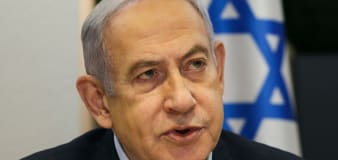
"Things got a bit out of twist," Netanyahu spokesman Mark Regev told AOL News, referring to the U.S.-Israeli tensions. "But we hope that we'll be back on track where we were before and proximity talks with the Palestinians can get going."
Regev said he did not expect Netanyahu to reveal details of the one-on-one meeting with the president.
The spokesman said that because he is in Washington with the prime minister, he could not comment on the approval of 20 new homes at the site of the former Shepherd Hotel in east Jerusalem.
But Regev did note that in his speech Monday before the American Israel Public Affairs Committee in Washington, "Netanyahu said there are some decisions that are not in his purview but in that of the Jerusalem planning commission, and he said he would not interfere with that."
It is also true, however, that some projects -- such as one planned for the neighborhood of Silwan -- have been put on hold after the prime minister appealed to Jerusalem Mayor Nir Barkat. A similar delay could still occur at the controversial Shepherd Hotel site as well.
In a sign that the crisis between the United States and Israel has not ended, the meeting between Obama and Netanyahu was brief, and there was no press coverage or even written statements afterward.
Speaking before the meeting, State Department spokesman P.J. Crowley said the U.S. hopes the indirect "proximity" talks between Israel and the Palestinians will lead to direct talks soon.
"Jerusalem is an important issue to both Israel and the Palestinians," Crowley said. "Our goal is to move the proximity talks forward to direct negotiations so final status issues can be discussed and resolved. Both sides have responsibilities."
The crisis between the U.S. and Israel began two weeks ago when Israel announced it will build 1,600 new homes in an ultra-Orthodox neighborhood of east Jerusalem. The timing of the announcement -- during a visit to Israel by U.S. Vice President Joe Biden -- embarrassed the administration and sparked harsh criticism of Israel.
In his speech to the AIPAC lobby group Monday, Netanyahu said that every Israeli government has built in east Jerusalem, which Israel annexed in 1967. The Palestinians say that east Jerusalem must be the future capital of a Palestinian state, and the U.S. says that the future of east Jerusalem must be determined by negotiations.

Netanyahu imposed a partial 10-month settlement freeze in the West Bank in November after U.S. pressure, but he says it does not apply to east Jerusalem.


Speaking to congressional leaders before his meeting with Obama, Netanyahu said the Palestinian demand for a complete freeze, including in east Jerusalem, is holding up the resumption of peace talks.
"We must not be trapped by an illogical and unreasonable demand," Netanyahu said. "It could put the peace negotiations on hold for another year."