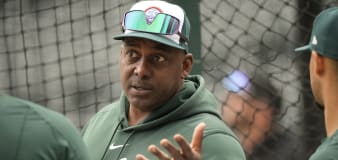
Every time Ryan Ludwick comes to the plate and the camera comes in tight on his face, he's ashamed of what it shows. Look closely and you'll see it, that little bulge under his lower lip. It's smokeless tobacco, more commonly called "dip."Ludwick is one of the hundreds of major leaguers who uses dip, even though he is well aware that he's doing no favors for himself or those who are watching him.
"I know it's not a healthy habit," the Cardinals outfielder said. "It's not something I'm proud of doing. I've built up to a point where it makes me feel relaxed when I hit."
Giants outfielder Mark DeRosa started using tobacco to pass the time on long bus rides in the minor leagues – where it is banned, by the way – and now he relies on four cans a week to help him get through his days and his at-bats in the big leagues.
"It's not something I'm proud of or something I want to continue doing," DeRosa said, echoing a common theme. "It's like any addiction. It calms me down before I go to the plate. You tell yourself that. Even though you know it's not reality, it's my reality."
It is a reality that could be changing, if Congress or Major League Baseball gets its way. Last month the House Energy and Commerce Committee convened a hearing focusing on the use of smokeless tobacco by major leaguers. The goal of chairman Henry Waxman (D.-Calif.) was to encourage MLB to ban the products in the big leagues, expanding a ban that's been in effect in the minors since 1993.
MLB Executive Vice President Rob Manfred told the committee that a tobacco ban in the big leagues is a "laudable goal," but the players' union stands in the way.
Share With the next Collective Bargaining Agreement set to expire in December 2011, a big-league tobacco ban is on MLB's wish list. While the union has said it is willing to discuss the issue, it is going to be tough to convince the players to accept a ban on an activity that is otherwise legal.
"They should worry about other things than dip," said one National League player who asked to remain anonymous because he said his wife doesn't know that he uses tobacco at the ballpark. "It's not against the law. Everyone else can do it. Why can't we?"
Giants reliever Jeremy Affeldt, who does not dip, said: "If it's legal in the United States of America, you can't say someone can't do it. It's a free country. You start going down those roads, taking away freedoms this country is based on. ... I think we are seeing signs of more and more of that happening and we need to back off."
Truth be told, companies restrict their employees from perfectly legal activities and behaviors all the time. MLB currently bans smoking cigarettes within view of fans or cameras. There are numerous rules mandating the way players must wear their uniforms. Any player who has been tossed for saying the wrong thing to an umpire will tell you that freedom of speech doesn't apply on a big-league field.
So the issue of banning dip in the big leagues is not about the law or freedom. It's just another term of employment, to be negotiated between the players and owners. As the sides go into their next labor negotiation, the question will be how hard the owners push for a tobacco ban, and how much the players resist.
By most estimates, about one-third of the players in the majors use tobacco. That vocal minority would obviously be against any sort of ban, so the question becomes how strongly the other two-thirds of the players feel about it. Most of them seem to want to support their dipping union brothers.
"Grown men can make decisions on what they put in their bodies," said the Rockies' Ryan Spilborghs, who is a non-user. "If a guy wants to dip, he can dip."
That feeling is not unanimous though. There are players who believe that, as role models, they ought to set a better example.
"I would be for [a ban]," A's infielder Eric Chavez said. "I don't do it. Sometimes when I'm watching the games you see a guy throw in a big dip and the camera focuses in on it, I know kids are watching. You want guys to be able to do what they want. Everyone is an adult, but you also have to be aware of the message that you send to kids. ... Since I don't dip, I think I'd be an advocate for trying to get it out of the game, or at least off the field."
Times Have Changed
When Bruce Bochy got into professional baseball in the 1970s, he heard that smokeless tobacco was a "healthy alternative" to cigarettes. The products were supplied in the clubhouse and many players chewed without giving it a second thought.
Over the years, though, things have changed. For starters, players rarely use chewing tobacco at all. Rather than the leaf style tobacco that comes in pouches, players prefer the finely ground tobacco that is packaged in cans. Users take a pinch and stick it between their cheek and gum and, essentially, suck on it. While it may be a little less noticeable than a guy chewing on a big wad of tobacco, it's no more healthy.
Cancer of the throat and mouth are commonly known to be directly caused by the use of smokeless tobacco. It is not a healthy alternative to smoking,
In the '90s, former big league Joe Garagiola Sr. began campaigning for players to quit using tobacco products. Garagiola visited clubs in spring training and showed them graphic images of former major leaguer Bill Tuttle, who lost most of his jaw to cancer. Tuttle died in 1998. Garagiola and Tuttle traveled the country on behalf of the National Spit Tobacco Education Program (NSTEP) of Oral Health America.
Garagiola, who is now 74, doesn't get around to speak to players as much now, but he was in Washington to plead his case last month.
"I would like the players ... who are role models; I don't care what anybody says ... to quit carrying a can of dip in their uniform pockets," Garagiola told the committee in a 15-minute speech during the April 14 hearing.
"Why can't baseball and the players' association right here get together and ban it? Take it off the field," Garagiola said. "Tobacco is tobacco is tobacco. ... Get it out of our game."
It has been out of minor-league baseball since 1993. Players are prohibited from using tobacco at the ballpark, on team buses or in team hotels. Umpires are responsible for reporting players who violate rules at the ballpark, and the managers are expected to police their clubs elsewhere. If a player is fined, the manager is also fined.
Former minor-league manager Todd Steverson said enforcement is difficult, though.

"I'm not checking pockets down there," said Steverson, now the A's first base coach. "If they have it, they have made the conscious decision to do it, knowing the rules. I'm not going to come to the ballpark every day and ask everyone if they have a can of snuff. ...You can't exactly tell what's in someone's mouth. But you have to assume a few have it in there, or have it well hidden."
"Do I think it's a good thing for kids to see? No. I agree with that 100 percent, but it's a decision I made. It's a nasty habit, a really nasty habit.
-- Ryan Ludwick Steverson said that MLB conducts unannounced spot checks of the clubhouse periodically during the season. The "dip police," as players refer to them, comb through the clubhouse and look for signs of tobacco, although they aren't allowed to touch anything, Steverson said.
The fines, which can be around $200, can be a hit to a minor-league paycheck.
"A lot of guys can't afford to take that risk," said A's reliever Brad Ziegler.
Once the players get to the big leagues, though, the only way MLB can deter the use of tobacco is by prohibiting teams from providing it in clubhouse. In fact, club employees are not even allowed to purchase tobacco products outside the clubhouse on behalf of players. A's equipment manager Steve Vucinich said that when Jim Fregosi was managing the Blue Jays, a member of the Oakland visiting clubhouse staff had to drive him to a nearby gas station, in his uniform, so he could buy cigarettes himself.

Vucinich, who has worked in big league clubhouses for more than 40 years, said that tobacco use "is not down as much as baseball thought."
A Part of The Game
Fact is, tobacco is still a cultural part of the game. Many players who use it insist that they only do it when they are at the ballpark.
"I'm not even close to being quote-unquote addicted," the anonymous NL player said. "I just do it at the field, because you are out on the grass with the guys. I don't do it at home with the spit cup and all that. I do it at the field. I have no urge to do it any other time."
When Bochy was asked if he'd ever tried to quit, he said: "I've quit. I quit every winter."
He pointed out that he made it "deep into spring training" this year before he started up the habit again. Bochy said that the tobacco actually helps him manage.
"It raises your awareness, your alertness," the Giants manager said. "It's a stimulant. It intensifies your focus, I think. If you are used to playing and seeing the game a certain way, for as long as I've been doing it, it's not easy to get off it."
Bochy is currently trying replace his dip with a tobacco-free substitute. The product, which comes in a can and has a similar texture, is made from spices and other ground leaves.
DeRosa, who hears about it from his 6-year-old daughter when she says "Daddy is putting Yucky in his mouth," said that he's failed whenever he's tried to find a substitute.
"I don't know what a serious chemical dependency is like, but it has nothing to do with an oral fixation, because I've tried the fake stuff," he said. "I've tried to go cold turkey. It has nothing to do with having it in your lip. It has to do with the nicotine going through your blood stream, either relaxing you or soothing you, pumping you up."
Spilborghs said he's tried dip, and he understands why players feel it helps.
"It's something to take your mind off things," Spilborghs said. "This is a high-pressure game, and nicotine helps take the edge off. There are other ways of doing it though."
Ludwick said he doesn't use tobacco in the offseason, but as soon as he gets into batting cage, he feels he needs it.
"I would love to quit eventually, especially because I have a 1 1/2-year-old son myself, but it's one of those comfort things," he said. "I'm sure when I'm done playing the game, I'll be done with it, but if they take it away, it will be a huge adjustment for me."
Kevin Kouzmanoff first identified himself as a non-user, but then he confessed to popping in a dip occasionally in the dugout: "I enjoy the flavor, but I'm not addicted."

The A's third baseman said the problem is not necessarily the tobacco use itself, but the visibility of it. There are plenty of players in the majors who use tobacco while hiding it as best as they can.
"You should at least make yourself look presentable," Kouzmanoff said. "Try to hide it."
Some will be careful to spit out whatever is in their mouths before doing television interviews. Some television crews also have a policy to cut away from players whenever possible if it's obvious they are using tobacco."Just don't have the can in your back pocket and don't dip in the dugout," Spilborghs said. "For the most part it's hidden. You can't tell who's dipping unless you see someone put it in his mouth."
During the Congressional hearing, Waxman cited a study by Harvard's Gregory N. Connolly, who found that tobacco use was shown on television for an average of nine minutes per game during World Series games from 1998 to 2005. That's the equivalent of millions of dollars worth of free advertising for the product, the study said.
It is an argument that is tough for the tobacco users to refute, especially because many of them are ashamed of the habit in the first place. Bochy said he strictly forbade his own two sons, who both played baseball, from using tobacco. Two big leaguers who are among the most media-friendly in baseball both refused to comment on their tobacco use.
Ludwick has trouble defending dipping.
"Do I think it's a good thing for kids to see? No. I agree with that 100 percent, but it's a decision I made," he said. "It's a nasty habit, a really nasty habit."
TV SoundOff: Sunday Talking Heads