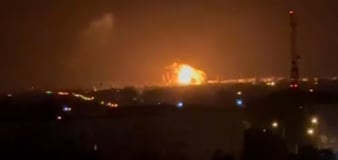
Now Usmani, an assistant professor at Ghulam Ishaq Khan Institute in Pakistan's North-West Frontier Province who recently completed five years as a Fulbright scholar in the U.S., is applying that expertise to the contentious debate over drone strikes. And his website, Pakistan Body Count, draws a striking conclusion about the unacknowledged CIA drone strikes in Pakistan: More than 90 percent of the reported casualties are civilians.

Since the beginning of the drone attacks, Usmani estimates that over 1,200 civilians have been killed by the strikes, compared to only 30 members of al-Qaida.
Usmani brings a unique background to the work. His work on blast simulations has looked at the details of a terrorist attack that may determine who lives and who dies. He and his colleagues found, for example, that circular crowds suffer the worst in terrorist attacks (more than a 50 percent death rate), while people arranged in rows, such as at prayer in a mosque, had only a 20 percent death rate.

Usmani's website looks at more than just drone strikes. He also counts victims of suicide bombings in Pakistan, which have been on the rise in recent years. Since 1995, more than 3,600 people have died in such attacks, according to statistics compiled on the website.
But Usmani's tally of civilian casualties from drone strikes is getting attention, being so at odds with statistics complied by U.S. observers -- even organizations like the New America Foundation, which concludes in its analysis that civilians make up about one-third of those killed in airstrikes by unmanned aircraft.
Like the New America Foundation, Usmani compiles his numbers from media sources. The difference, however, is that he counts only al-Qaida, not the Taliban, as combatants. "Neither U.S. nor Pakistan release any detailed information about the victims," Usmani tells AOL News in explaining his analysis. "So when U.S. likes to call everybody Taliban, I call everybody civilians."
Since the United States does not officially acknowledge carrying out drone strikes inside Pakistan, no official death tolls are provided. And since Pakistan strictly controls access to the tribal areas, most of the press reports rely on second- or third-hand sources.
In the absence of official data, those keeping track of drone casualties often come to very different conclusions. "Since 2006, there have been 1,185 leaders and operatives from Taliban, al-Qaida and allied extremist groups killed, and 95 civilians killed," Bill Roggio and Alexander Mayer estimated in an analysis on the Long War Journal website of drone strikes since 2004.
If accurate, that represents about a 7 percent civilian casualty rate.
Roggio says his numbers differ from those provided by the New America Foundation because they identify as civilian casualties only those not specifically linked to al-Qaida or the Taliban. "I'm using the opposite approach," Roggio tells AOL News. "I only count them when they are identified as civilians."
All numbers are bound to be inaccurate, Roggio says, stressing that the important issue is that the United States is avoiding mass casualties. "We're not firebombing Dresden or nuking Hiroshima," Roggio says. "The numbers matter in the sense that they show a concerted effort to keep civilian causalities low."
For Usmani, the issue is not just the numbers, but also the drone strikes' effect on the perception of the United States in Pakistan. They drive Pakistanis to terrorism, he argues. Those whose homes and lives were destroyed in drone strikes have nothing to live for and turn instead to suicide bombings, "and we Pakistanis are paying the price," he says.
Peter Singer, a senior fellow at the Brookings Institution and the author of "Wired for War," says he doesn't "put a lot of stock in any of the numbers" on casualties. There are, he writes in an e-mail to AOL News, simply too many problems with the sources from which the casualty numbers are drawn to reach any definitive conclusions.
Rather, he insists, the differences in numbers reflect how attitudes toward the drone strikes differ between the United States and Pakistan. "This is how what I believe to be our painstaking efforts to act with precision can emerge with a very different narrative 7,000 miles away, especially when viewed through a cloud of anger," he writes.