While hurricanes can occur at any time of the year, the season is officially listed as lasting from June 1 through Nov. 30. The season peaks around Sept. 10, and the greatest number of tropical storms and hurricanes occurs from August through October.
June -- and even the first half of July -- is considered the beginning of the season, but when storms form, they often do so close to land, with most early-season storms developing in the Gulf of Mexico and tracking north toward the U.S. coastline.
Recent early-June tropical development includes the short-lived Tropical Storm Barry in 2007 and Tropical Storm Alberto in 2006.
Barry developed near the Yucatan Peninsula on June 1 and moved over western Florida on June 2. Alberto moved from the northwestern Caribbean on June 10 to the Florida Panhandle June 14.
The strongest tropical system recorded in June was the powerful Hurricane Audrey, which made landfall in southern Louisiana on June 27, 1957, as a Category 4 storm, with a sustained wind of 145 mph.
Quick-developing and quick-hitting storms are probably not what we first think of when it comes to hurricanes. The classic hurricane is one that forms a thousand or more miles away from the U.S. -- perhaps even just offshore of Africa. Forecasters then track the hurricane for days -- perhaps 10 or more -- monitoring how it strengthens and weakens based on various weather factors. We often follow news of devastation in other areas before there is serious concern about a U.S. landfall.
These long-lived hurricanes complete their life cycles once they move inland or encounter cooler water, often becoming non-tropical low-pressure systems in the process.
Early-season storms are not typically like that.
It's unlikely that meteorological conditions, including sea surface temperatures, will be favorable over a vast area of the Atlantic, which is needed to result in a storm with a prolonged track during the first part of the season.
What's more likely is that a tropical storm or hurricane will form close to land and make landfall fairly quickly. Rather than seven or 10 days to track a storm, there might be just hours or a couple of days before a tropical storm or hurricane moves inland. The development might start after a non-tropical low-pressure system or a cold front leaves a little energy behind, which becomes a tropical system as it's left to interact with the rapidly warming water.
This type of storm can, of course, occur during the heart of the season, but during the start of the season, nearly all storms are of this nature. Early-season development might take place along the Southeast coast or in the northeastern Caribbean, but it's most likely to happen in the Gulf of Mexico.
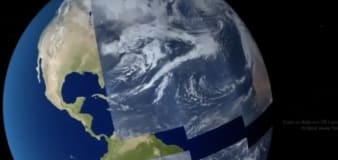
As of this morning, the National Hurricane Center was not monitoring any areas for potential development in the Gulf of Mexico, but it was watching a cluster of thunderstorms in the northwestern Caribbean. Forecasters say that disturbance has only a 10 percent chance of developing, but that could change quickly at this time of year.