AUSTIN, Texas -- Leaders of the University of Texas peered into what would have been the brand new frontier of college athletics and seemed quite fascinated with the possibilities.But Texas decided Monday to remain with what was familiar and that is Big 12 Conference. The school turned down an offer to join the Pac-10 and become the critical piece of the first 16-school mega conference. UT officials held a press conference Tuesday on campus to announce their decision, which likely saved the Big 12 from dissolution.
The one-time 12-member conference will make it a go with 10 members after Colorado and Nebraska broke ranks last week. Colorado went to the Pac-10, Nebraska to the Big Ten.
• Texas Stays Home
• Dan Beebe Teleconference
• Twitter Hackers' Fake Report
• Where Things Stand
• Texas-Sized TV Network?
• Pac-10 Not Empty-Handed
• Big East to Stand Pat
• Nebraska Joins Big Ten
• Colorado to Pac-10
• Boise State to Mountain West
• Lapointe: Tradition Loses
• Moore: NU Shucks Tradition
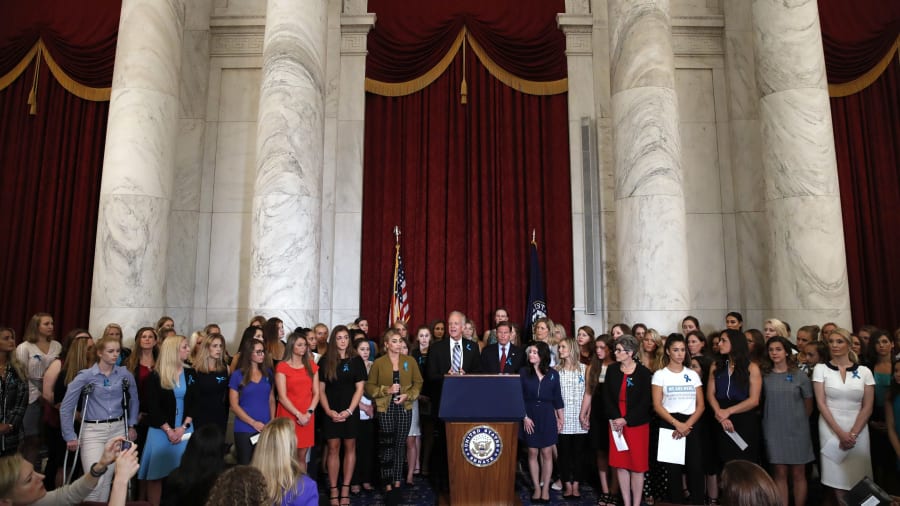
"I am pleased to announce today that the University of Texas at Austin is reaffirming its commitment to the Big 12 Conference," said UT president Bill Powers (above). "This is a long-term and unequivocal commitment. After spending several months examining and evaluating our options in the changing the world of Division I athletics, we've decided that the Big 12 provides best long-term opportunities for this university."
The evaluation process revealed to Texas, Texas A&M, Oklahoma, Oklahoma State and Texas Tech – the five school that all seemed ready to bolt on Friday – that staying in the Big 12 had the least impact on their athletes, produced favorable financial returns and was in the best interest of the conference's partners and fans.
Most of the speculation Monday was that Big 12 commissioner Dan Beebe was able to lure Texas back into the fold with the promise of a richer television deal that could help land UT as much as $25 million per season, while OU and A&M would receive $20 million. Texas will go forward with launching its own Longhorns TV network, a venture that had been in the works for two years but would not have been possible in the Pac-10. Texas would get to broadcast one of its football games live on the network that would primarily be a showcase for the Longhorns' non-revenue sports.
But, oddly enough, Powers said Tuesday that Texas has received no guarantees in terms of increased dollars, but it is confident Beebe will be able to make the television package as lucrative as the Big Ten, Pac-10, SEC and ACC in years to come.
Share
"We have had indication that when we go forward, it will with a very strong economic [plan]," Powers said. "We did not have any guarantees from the league or our northern partners. There have been reports that there is going to be a special deal for some of us using penalty money or other money to guarantee Texas and possibly other schools of particular value, but we were not part of that, that was not part of our consideration and we oppose that kind of deal."
Beebe said in a conference call on Tuesday that Texas, Texas A&M and Oklahoma would indeed receive a bigger portion of the exit money paid the league by Colorado and Nebraska, though a Big 12 official said the three schools have not accepted any offer for exit fee revenue and no formal plan has been proposed
What seemed to be the deal clincher to make the conference work is an agreement that ABC/ESPN would not downsize its $480 million contract with the Big 12 because two members are gone, the fact a Big 12 championship game will go away once Nebraska and Colorado are gone would not affect television revenue and that money from the two exiting schools' buyouts would line the pockets of the remaining schools. It all adds up to less means more in a smaller conference."I am not in the discussions with the networks," said UT athletic director DeLoss Dodds, who was instrumental in forming the 14-year-old Big 12 and is by far the most influential athletic director in the conference. "But I know this, we are in good shape."

A 10-member league -- though expansion in the future has not been ruled out -- means in football there are no longer divisions and all teams will play each other every season,. In basketball the league will adopt a double round-robin format where all teams play each other twice.
UT football coach Mack Brown and men's basketball coach Rick Barnes seemed to favor the new formats.
"It's very difficult in my estimation to crown a champion unless you play everybody in the league. I don't think it's fair that at certain times you may not play the best two teams and have a chance to win," Brown said. "I like the fact there are nine and we will all play each other. I understand right now we wouldn't need a championship game because we all play each other and I think that is fair because it's a more pure champion."
Barnes believes the new format and the more concentrated strength with non-basketball factors Nebraska and Colorado out of the picture makes the Big 12 the strongest basketball league in the nation.
"Hopefully, you can show people you don't have to have big numbers," Barnes said. "I like the round robin. You can't do it with 12 teams. You can't play 22 games and keep your national schedule. But 18 is a perfect number because from a competitive standpoint, you add two more great gates to your schedule."
While the feeling that prevailed Monday was one of togetherness, there seems to be major questions of disgruntled feelings after so much transpired over the past few weeks. Missouri began the conference defection speculation with a flirtation with the Big Ten after the league said it would explore expansion. Then you had Texas, Oklahoma, Oklahoma State and Texas Tech all seeming ready to head to the Pac-10, while Texas A&M turned its back on the allegiance and seemed to favor joining the SEC if the Big 12 did fall apart.
"We live in athletics, we beat each other on Saturdays and then we love each other on Sundays. We live in competition and through that we remain friends."
-- DeLoss Dodds, University of Texas athletic director But Dodds tried to shoot done any notion that there are trust issues among the remaining 10 members.
"We live in athletics, we beat each other on Saturdays and then we love each other on Sundays," he said. "We live in competition and through that we remain friends. The Big 12 ADs are going to be great, they have always been great. We have our separate schools but those differences are not carried outside so I feel good about the relationships between the schools."
Most believed that a major part of getting these schools to sit back down at the table would involve a heavier penalty for leaving than in the past. But Powers indicated that wasn't the case on Tuesday.
"At the Big 12 (spring) meetings, we discussed ways of making the conference stable. We agreed on the way to make the conference stable is public, unequivocal long-term statements of commitment."