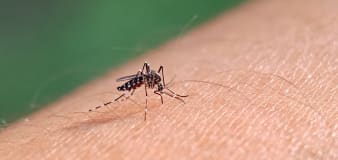
Some researchers now believe the mysterious four-legged killer and livestock blood sucker may, in fact, be coyotes infected by tiny, eight-legged parasites, or mites.
"It's easy to try and convince people that something might exist because of fears and speculation, but it's a whole lot harder to prove that something doesn't exist," said Robert Roy Britt, editor-in-chief of LiveScience.com.
"It's a wonderful explanation and I'm glad there's scientific proof for what we already knew, but it doesn't explain a lot of the reports from Puerto Rico and other places," said Loren Coleman, director of the International Cryptozoology Museum in Portland, Maine.
The strange physical characteristics of these creatures have been seen on videos and photos taken of the hairless coyotelike animals in rural areas.
"The identification of some chupacabras as being mangy coyotes is nothing new -- I wrote about it years ago," said Benjamin Radford, managing editor of the Skeptical Inquirer magazine and the "Bad Science" columnist for LiveScience.com.
"It's interesting and largely correct as far as it goes. That is an answer for several of the found chupacabra carcasses," Radford told AOL News.
During a five-year chupacabra investigation, which took Radford to the jungles of Nicaragua to Puerto Rico, New Mexico and dusty Cuero, Texas, he found himself face-to-face with the beast, albeit dead, when he visited Phylis Canion, who discovered one of the animals near her ranch.
"It was in a plastic trash bag in her freezer -- she kept the head. You could see the teeth and eyes. It looked like a really creepy, scary -- but not necessarily supernatural -- canid," Radford said. "It was clearly related to dogs or coyotes, from the shape of the head and the canine teeth."
Even though Radford approached the whole chupacabra debate from a skeptical point of view, the sight of the creature close up was a bit off-putting to him.
"Absolutely! It was weird. First of all, it was really pungent and gamy, as you can imagine a severed head would be. She unwrapped the plastic and pulled it out. It was like dark gray, moist, leathery skin.
"I'd never been within touching distance of an alleged chupacabra carcass."
DNA testing revealed this particular animal was a coyote.
The chupacabra has been categorized as a cryptid, a term that describes animals that haven't been officially confirmed by science, such as Bigfoot or the Loch Ness Monster.
"The thing that's being ignored by the media is that in the initial chupacabra reports, the creatures had hair on their bodies, and they were not on all fours -- they were on two feet," Coleman said. "The cryptid is described very much differently from the popular cultural image that we're getting from Texas."
Radford agrees with this -- to a point.
"I haven't found any evidence that the chupacabra exists, certainly outside of being a sociocultural entity. They exist in the same way that Santa Claus exists. Again, there's no bones, no teeth, no verified remains.
"So, why are people reporting animals that don't seem to exist? There would have to be a breeding population of them -- there can't be just one or two of them."
LiveScience's Britt suggests that eyewitness accounts don't always point to something mysterious as the cause.
"It's the same with Bigfoot and UFOs and anything that seems to be inexplicable. Just because some people can't explain what they saw, doesn't mean it's proof that there's a mysterious creature out there.
"Often readers will criticize us for even bringing this stuff up. Because they feel like giving any kind of ink to chupacabras is just furthering the myth."
One thing about the whole chupacabra legend that's most interesting to Radford is that the animal is a vampire.
"Unlike Bigfoot or the Loch Ness Monster, the chupacabra sucks blood -- that's its main characteristic. When you look back at the vampire tradition in Europe, Africa and Latin America, you can see how those earlier vampire traditions essentially created the chupacabra."
And while cryptozoologist Coleman thinks there's an unknown animal out there that's worth investigating, he agrees that the canine-type animals of recent times are probably not the real chupacabras.
"The exaggeration of the body form, without hair, always makes people think that they're looking at a monster. This isn't a monster -- it's just an animal that has a medical condition."
Make your life more weird! Follow AOL Weird News on Facebook and Twitter.