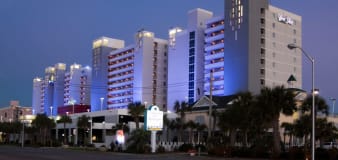
LAKE WORTH, Fla. -- Dean Tolson will wake up here Christmas morning after another restless night in a strange little bed, 3,000 miles away from home, surrounded by strangers and drug addicts, his day already dictated to him. There will be no presents to open. No tree to admire. No family to hug.This isn't jail. It just feels like it sometimes. Santa Claus doesn't stop at the detox center, where the distinction between inmate or patient often feels thin.
Yet there is no place else he would rather be.
"This place is my Christmas present. And it comes with a big bow on it,'' Tolson says as a tired smile emerges, his face drained from several days of emotional and physical strain. "This is how I'll get my life back.''
Tolson, who played three seasons with the Seattle Supersonics (1974-78) in the NBA, will be spending the holidays at Behavioral Health of the Palm Beaches, a drug treatment center that specializes in dependency issues.
It's where the desperate go.
It's where Tolson has come to reclaim his dignity, prying him loose from the powerful opiates, the pain medication that has dominated his existence and sucked the joy out of his life the past several years.
It's where he has come to stop the depression, to stop the wondering if life is really worth living, to stop the days when all he can do is lie on the floor and look at the ceiling because it's too painful to move.
It's where he has come to stop the worry, the paranoia, the fear of what might happen if the pills in his pocket disappear, knowing the intense physical pain is never too far away.
It's where he has come to reclaim his only child, a 16-year-old daughter who hates what he has become, an addict who still struggles to admit he is one. She lives 500 miles away with her mother, but he sees her every time he closes his eyes.
"There were days when all I could do was lie there and cry,'' Tolson said, sitting in a treatment center reception area. "There were days when you didn't even want to wake up. It was a living hell at times. It was misery. It hurt so bad sometimes, it was a sweet-mother-jesus, take-me-away pain. I wanted that part of my life to end.''
Tolson, 59, has become the first former NBA player -- kind of a test case -- to enroll in the Pain Alternatives, Solutions and Treatments program (P.A.S.T.), a New Jersey-based medical group that recently has partnered with the National Basketball Retired Players Association to help those in need.
P.A.S.T. already had been working with former NFL and Major League Baseball players, helping them with a variety of medical and behavioral issues, often a result of a career in sports. The services are provided pro bono, for those like Tolson without the necessary health insurance or the ability to pay for the treatment. (pastusa.com to read more.)
![]() |
| Randy Grimes and Dean Tolson |
"It's the hardest thing I ever did," he said about getting off pain medication. "Going against Joe Klecko, Michael Carter or Randy White was nothing compared to this. But I came in with the desperation of a drowning man. I just want to help others get through it now. It's such a widespread problem with former players in a lot of sports.''
Tolson has suffered for years from a herniated disc in his lower back, along with a severely pinched nerve that causes sciatica problems that stem from a career in pro basketball.
After leaving the Sonics, he played eight more years, both overseas and in various minor leagues in North America. The pounding took its toll. And then in retirement, he ruptured that disc in his back when he tried to do too much in a charity game in Seattle.
All the pain medication he took when he played with various minor ailments during his career -- ankle, knee, hamstring, hand -- paled in comparison to what he started taking long after he walked away from the game.
Although surgery was recommended, the lack of health insurance, and his fear of the surgery, made it easy to push the addictive pain medication instead. Doctors at the Veteran's Administration in Seattle made Vicodin the drug of choice. And pretty soon, he couldn't live without it. Now he can't live with it.
"I'd get 150 pills a month for six months without ever having to see the doctor. They just came in the mail. It made the pain a little more bearable, but that's no way to live,'' he said. "It was miserable at times. After feeling sorry for myself for so long, I had to do something.''
Tolson was never one to shy away from a challenge. Once he reached the NBA, he became the poster child for academic abuse in college sports. He spent four years at the University of Arkansas, but the Sonics were shocked to discover he hardly could read or write. His story was chronicled in Sports Illustrated after he went back to college and got his degree in 1988. Then just over three years ago, with his dependence on pain medicine growing, he managed to finish his Master's degree by taking all but one course online.Six months ago, after hearing about the Retired Athletes Medical Resource Group, which is part of P.A.S.T., he started making phone calls. The NBRPA paved his way into the program.
"In the first 10 minutes I talked with him, he was just crying on the phone -- literally -- begging for something to get him off of the pain medication,'' said Jennifer Smith, director of player programs for P.A.S.T. "It was obvious, he was ready for help.''
Tolson arrived at Behavioral Health earlier this month, spending his first five days in the detox phase, spending much of that time being physically ill. There was vomiting, nausea, insomnia, aches and chills. Then came the twitching and uncontrollable shakes as his body fought the craving for the drug he had taken for so long.
"These drugs just become your life in these cases. You can't go to sleep at night until you know you have enough of the drug for the next day,'' said Arthur Rosenblatt, the doctor working with Tolson at the Behavioral Health center. "And withdrawal from opiates is very painful. Although you won't die from it, you'll wish you were dead. It's horrible. But it's something you have to go through.''
Next came the pain management sessions, the alternative medicines and the one-after-another therapy sessions, teaching patients about dealing with sobriety. On Christmas Eve, Tolson will go from one group session to another, finishing his night at an AA meeting nearby. And Christmas Day, it will be much of the same, learning to deal with life after narcotics.
Regimentation is the norm. Early to bed and early to rise is reality. Chores throughout the day. Responsibilities to meet. Meetings and more meetings. It's not a fun time, yet there are a dozen former NBA players already lining up behind Tolson to begin a program tailored to their individual needs.
"There are a lot of reasons why I'm here,'' Tolson said. "I want to get my life back, and they have given me that chance. I love my daughter. She's the only one I'll ever have. And when I'm done here, I won't ever go back to the Vicodin. I just hopes she accepts me as her father again. I won't be the same man that I've been.''