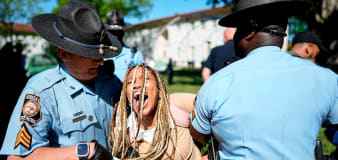
Yes, there was the birther who screamed, "Except Obama ... help us Jesus," as Rep. Frank Pallone, D-N.J., read the section stipulating only "a natural born citizen" may be president. U.S. Capitol Police dragged her from the gallery.
And there was the symbolism of civil rights hero Rep. John Lewis, D-Ga., intoning the words of the 13th Amendment that abolished slavery, evoking applause and a standing ovation in the morning's most emotional moment.
This being Congress, however, the opening act came with a partisan preamble.
Washington Democratic Rep. Jay Inslee inquired about how it was decided which parts of the Constitution would be read and which parts omitted.
Rep. Jesse Jackson, D-Ill., spoke for African-Americans, women and others not enfranchised in the original draft and warned against historical revisionism. It was not right, he said, to redact despised sections such as the three-fifths clause because "many of us don't want that to be lost upon the reading of our sacred document."
Rep. Bob Goodlatte, R-Va., mindful of the political perils, stood firm. The event's organizer said he consulted with experts at the Congressional Research Service and the Library of Congress and decided that any sections superseded by amendments would be omitted.
Indeed, the entire 18th Amendment legalizing prohibition was skipped over -- although the 21st that repealed it was read aloud.
Democrats and Republicans lined up to take turns to read for more than an hour and a half. Some highlights from the line-by-almost-every-line reading:
- New Speaker of the House John Boehner got the honor of reading the famous preamble and did it without shedding a tear. He was followed by the woman he replaced, Rep. Nancy Pelosi, who read Article I, Section 1 granting all legislative powers to Congress.
- It was first come, first served except for Lewis and the new chairman of the House Judiciary Committee, Rep. Lamar Smith of Texas. He reserved the first words of Article III, which established the judicial branch, for himself.
- Of the five congressmen who read the names of the signers, none was from the 12 original states that sent delegates or the 13th, Rhode Island.
- Through an apparent glitch, Article IV, Section 4 -- The United States shall guarantee to every State in this Union a Republican Form of Government, and shall protect each of them against Invasion; and on Application of the Legislature, or of the Executive (when the Legislature cannot be convened) against domestic Violence -- was skipped over.

- Rep. Ed Perlmutter, D-Colo., read 14 words from Article I, Section 9 about taxation. Under a strict reading of the ground rules, though, it likely should have been excised because of the later passage of the 16th Amendment that legalized the federal income tax.
- While the fugitive slave clause and other related sections were expunged, not every vestige of the peculiar institution was left out. Freshman Democrat Bill Keating of Massachusetts got stuck with Article I, Section 9, a reminder that the United States didn't stop importing slaves until 1808.
- Hawaii Democrat Mazie Hirono may have left the chamber wondering what the meaning of the word "the" is. Here is the clause she had to read: The Word, "the," being interlined between the seventh and eighth Lines of the first Page, The Word "Thirty" being partly written on an Erazure in the fifteenth Line of the first Page, The Words "is tried" being interlined between the thirty second and thirty third Lines of the first Page and the Word "the" being interlined between the forty third and forty fourth Lines of the second Page.
- Other members lucked out. Democrat Gabrielle Giffords of Arizona read the First Amendment, arguably the most important of the 10 in the Bill of Rights. Republican Frank Guinta of New Hampshire, who was endorsed by the NRA, got the Second Amendment. Freshman Republican Ann Marie Buerkle, whose upstate New York district isn't far from the site of the first women's rights convention, read the 19th Amendment giving women the right to vote.
- Goodlatte, in charge of calling members to the podium, paused when he got to the 10th Amendment and read it himself, winning points with tea party advocates who complain its words have been trampled by the federal government.
- The parties took turns until two Republicans in a row read the main clauses of the 22nd Amendment, which limited the president to two terms. That seemed somehow fitting given that the 1951 amendment was viewed by Democrats as posthumous revenge against Franklin Roosevelt by Republicans, who would later rue the amendment as Ronald Reagan's second term drew to a close.
- By the 25th Amendment dealing with presidential succession, Goodlatte appeared to have run out of Democrats. Republican Stephen Fincher of Tennessee read the 27th and last amendment before the chamber broke into applause.
- One member conspicuous by her absence among the readers was Tea Party Caucus Chair Michele Bachmann, R-Minn., whose schedule this month includes hosting Supreme Court Justice Antonin Scalia for a class on the Constitution and traveling to Iowa to test the presidential waters.

The Mortgage Mess: Just How Many Screwups Were There?