At least eight people have been killed in the protests since Wednesday, The Associated Press reported. More than 800 have been injured, CNN reported, citing a statement by Egypt's health minister on national television. Arson and looting have broken out across the capital, and several news outlets reported that foreign journalists have been systematically attacked by pro-government forces.

President Hosni Mubarak's supporters beat anti-government protesters who have vowed not to go home until the president resigns.

In a move that appeared to be aimed at mollifying demonstrators clamoring for an immediate end to Mubarak's rule, Egyptian Vice President Omar Suleiman announced today that neither President Hosni Mubarak nor his son, Gamal, would be a candidate in the fall elections, The Los Angeles Times reported.
Newly appointed Premier Ahmed Shafiq, meanwhile, apologized today for the "catastrophe" of the "fatal error" that led to the clashes and pledged an investigation into the violence in Cairo's Tahrir Square, CNN said.
Rival fighters began streaming into the square before dawn today, as shots rang out. Haunting entreaties have been popping up on Twitter: "Thugs are heading to Tahrir. Our heroes are ready, but we would love to have any support," wrote Rafaat, who identified himself as an Egyptian-American. "Watch us world."
Egypt's army, after more than a day of telling protesters to go home but failing to halt clashes, took up positions today between the warring groups, creating an 80-yard buffer zone, Reuters reported. Soldiers fired warning shots, then formed a human chain in front of the pro-democracy barricades, keeping pro-Mubarak fighters away, Al-Jazeera reported. Tanks that have had their guns pointed toward anti-government protesters for days have now turned the weapons to face down pro-Mubarak rioters, the BBC noted.
Rock-hurling mobs bolstered by apparent protection from the army pushed pro-government forces across Tahrir, pelting them with stones from a highway overpass above. More gunshots rang out, and there were several reports of foreign journalists being attacked. The U.S. State Department condemned a "concerted campaign to intimidate international journalists in Cairo and interfere with their reporting," spokesman P.J. Crowley wrote on Twitter.
Human rights groups say more than 150 people have died altogether.
An unknown number of prisoners have broken out of Egyptian jails in the past week, as order has broken down amid mass protests across the country. Among them was Sami Chehab, a member of the extremist Lebanese group Hezbollah, Egyptian security sources told Reuters today. Chehab, who was serving a 15-year sentence for planning attacks, escaped Sunday, and sources close to his family told the news agency he's already left the country.
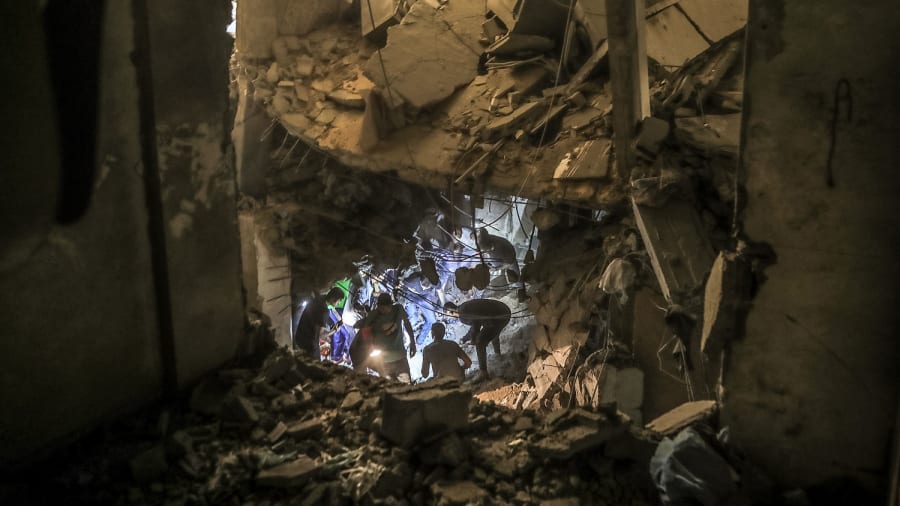
Clashes erupted Wednesday when mysterious supporters of Mubarak -- unseen in the past week -- stormed Tahrir Square, many of them on camels and horses, beating unarmed protesters with metal rods, whips and clubs. Demonstrators broke bits of sidewalk into sharp stones, throwing them back at the seemingly well-coordinated force. As time passed, the weapons got more deadly: meat cleavers, Molotov cocktails, live bullets.
It was a heartbreaking turn of events after eight days of mostly peaceful but fervent protests, tacitly backed by the military, that emboldened Egyptians to believe they could break free from 30 years of Mubarak's authoritarian rule.
The government supporters who entered the fray were not uniformed, but many protesters suspected them of being plainclothes agents of Mubarak's regime. Such forces have been deployed frequently during his decades-long rule, intimidating civilians during elections and other times of political sensitivity. Plainclothes forces have been blamed for kidnappings, torture and abuse.
It was impossible to verify the attackers' true identities, and even if some of them were secret police, they were joined by an unknown number of civilians whose support for Mubarak seemed genuine.
Several unidentified people told The New York Times that ruling party operatives offered them 50 Egyptian pounds -- less than $10 -- if they agreed to demonstrate on Mubarak's behalf. Protesters also showed journalists ID cards belonging to police and ruling party operatives who had infiltrated Tahrir Square. Most of the Mubarak supporters carried identical Egyptian flags and printed signs, the paper said.
Opposition leader Mohamed ElBaradei said the seemingly well-orchestrated violence was "an indication of a criminal regime that has lost any common sense."
"When the regime tries to counter a peaceful demonstration by using thugs ... there are few words that do justice to this villainy, and I think it can only hasten that regime's departure," ElBaradei told The Guardian. He said any Egyptians who may have been willing to give Mubarak the benefit of the doubt now realize their folly.
But Shafiq -- appointed as prime minister just days ago -- denied that government agents were behind the attacks and vowed to investigate.
"When investigations reveal who is behind this crime and who allowed it to happen, I promise they will be held accountable and will be punished for what they did," Shafiq said today, according to the BBC. "There is no excuse whatsoever to attack peaceful protesters, and that is why I am apologizing." He urged the protesters "to go home to help end this crisis."
Meanwhile, Washington appeared to be losing patience with its ally Mubarak, with White House Press Secretary Robert Gibbs saying that "if any of the violence is instigated by the government, it should stop immediately."
"The time for a transition has come and that time is now," Gibbs told reporters. He appeared to be clarifying President Barack Obama's statement earlier this week, calling for reforms but stopping short of saying explicitly that Mubarak must leave office immediately.
Echoing Sen. John Kerry's New York Times op-ed demanding that Mubarak step down, Republican John McCain said the same on Wednesday. "Regrettably the time has come 4 Pres Mubarak 2 step down (and) relinquish power," McCain wrote on Twitter.
Secretary of State Hillary Rodham Clinton phoned Suleiman -- handpicked by Mubarak just days ago -- and condemned the "shocking" clashes in Cairo, the State Department said. "The secretary urged the government of Egypt to hold accountable those who were responsible for violent acts," it said in a statement.
Egyptian state TV reported today that Suleiman has started a "dialogue" with his regime's opponents but did not give details. It was unclear whether the gesture was one of Clinton's demands. Opposition groups have so far refused to talk until Mubarak resigns, and they set a deadline of Friday for him to do so.
Pro-Mubarak forces deployed in Cairo's streets early Wednesday, hours after the president took to the nation's airwaves with a concession, saying he would step down after the September elections. But his speech late Tuesday was also defiant, saying he has fought all his life for Egypt and intends to die there -- an apparent jab at those who've called for him to go into exile.
Meanwhile, unrest is spreading to other Arab nations.
In Yemen today, 20,000 people packed streets in the capital Sanaa to call for their leader's ouster. A day earlier, Yemeni President Ali Abdullah Saleh promised not to extend his time in office after his current term ends in 2013 -- a promise that would have been shocking just weeks ago, before change began swirling across the Middle East.
Smaller protests have taken place in Sudan in recent days, organized on Facebook in much the same way as those in neighboring Egypt and Tunisia. Jordan's King Abdullah also sacked his Cabinet this week after more protests there.

The Mortgage Mess: Just How Many Screwups Were There?