AOL News has a new home! The Huffington Post.

Click here to visit the new home of AOL News!

Hot on HuffPost:

See More Stories
World

Libya Descending Into Hell, Rescued Britons Say

Feb 24, 2011 – 9:54 AM
Text Size
Theunis Bates

Theunis Bates Contributor

LONDON -- The first wave of rescued Britons to arrive back in the U.K. from Libya have described the bloody crackdown being carried out by Col. Moammar Gadhafi's security forces, saying they saw protesters executed in the street and military helicopters open fire in the capital Tripoli.

About 120 passengers landed at London's Gatwick Airport this morning after being evacuated from the North African nation on a plane chartered by oil giant BP. They told friends, family and a huddle of reporters how Tripoli International Airport had become a "zoo," with thousands of terrified people trying to crowd onto any available flight. All were desperate to escape a "hellish" city, where gunfire rang out all night long and smoke climbed from burnt-out buildings in the morning.
This Wednesday, Feb. 23, 2011 photo made available in Rome Thursday Feb. 24, 2011 shows people outside Tripoli's International airport. European countries are sending planes and ferries to Libya to evacuate their citizens, and some oil and gas companies pulled their foreign staff out and suspended operations. Air passengers who managed to get out of Tripoli described a scene of chaos at the airport, with people shoving and climbing over each other to get on planes  (AP)
AP
Pictured are people outside Tripoli International Airport on Wednesday. Air passengers who managed to get out of the country described a scene of chaos at the airport, with people shoving and climbing over each other to get onto planes.

Anne Smith, a 61-year-old English teacher from the northern city of Manchester, told the London Times that she had seen government security forces gun down a group of protesters in broad daylight.

"I heard some shouting in the street", she said, "so I went up onto the roof [of the school in Tripoli], and a young man came round the corner. As he did, the police came flying around the street. [A] young man jumped out [from the police car] and shot them in the street."
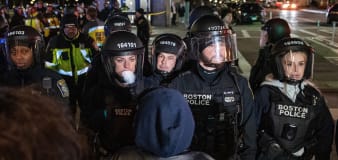
She added, "The protesters had no weapons at all. There were maybe a dozen security guys, and they fired gas canisters intro the crowd." When the police realized they were being watched from the school roof, they opened fire. "They looked up at us and shot live rounds at us," Smith said. "I've never seen anything like it. You could actually see the bullets."

Another escapee, Jan McKeogh -- a 63-year-old schoolteacher from New Zealand -- told the Press Association that she had heard of "absolute atrocities" that were too shocking to describe. She said that she decided to flee the country after military helicopters were deployed in Tripoli.

"Monday night was the turning point for us," she said. "Chinooks flew over our house, and there were machine gun blasts shortly afterward. It's usually a very, very safe area, but there were absolute maniacs over there."
McKeogh, who has worked in Libya for the past four years, said that "thousands and thousands" of people were now camping outside the airport, and that at least 200 British citizens were left outside the building, as they couldn't get through the "sea of people" crowding the terminal.

Ewan Black, an information technology support worker for an oil company, told the BBC that he narrowly scraped his way onto BP's rescue flight. "Tripoli Airport is a bit of a zoo," said Black, who is now on his way home to Fife in Scotland. "[Airport authorities] were only opening the [main] door a foot at a time to let in one or two at a time, and when you have got two or three hundred people behind you pushing ... I was on my knees at one stage, so was my colleague."

He was rescued by a Libyan police officer, who pulled Black and a colleague through the door when he saw their passports. "I am recovering now," he said, "but I'm just glad to be home."
An image grab taken from footage broadcast by the Libyan state television on February 24, 2011 shows burnt cars in Tripoli. Residents of Libya's dissident-held east, frenzied by a deadly crackdown by Kadhafi's crumbling regime, vowed to march on the capital Tripoli as a string of towns famous as World War II battlegrounds fell under their control. (Libyan TV/AFP/Getty Images)
Libyan TV/AFP/Getty Images
An image taken from footage broadcast by Libyan state television on Thursday shows burned cars in Tripoli.

Although Britons are now arriving back in the U.K., Brits stuck in Libya and opposition politicians at home have slammed the government for its belated evacuation efforts, pointing out that thousands of citizens -- Americans, French, Chinese, Russians, Turks, Poles and Bulgarians -- were already on their way home by the time the first British jet arrived Wednesday night in Libya.

Foreign Office officials have said that they struggled to secure permission from Libyan authorities for flights to land at Tripoli -- an unusual excuse, as other nations ignored Libya's rapidly collapsing bureaucracy and flew straight into the country. The government has also said that it had difficulty chartering rescue flights, as many commercial carriers were unwilling to provide planes for such a risky operation.

However, Douglas Alexander -- foreign affairs spokesman for the opposition Labour Party -- has questioned why the government didn't deploy military aircraft for the operation. (One of the Royal Air Force's Hercules transporter aircraft finally landed in Tripoli earlier today.)

Prime Minister David Cameron this morning apologized for the delay. "Of course I am extremely sorry. The conditions at the airport have been extremely poor," he told the BBC. "There are going to be lessons to be learned from this, and we will make absolutely sure that we learn them for the future, but right now the priority has got to be getting those British nationals home."

In recent days, many Brits have been helped in fleeing the country by foreign nations, including oil worker Bryan Richards, who on Wednesday secured a seat on the Polish president's official plane. "I am not quite sure how it came about, but we had a call saying that there's a Polish plane going with 50 seats," he told BBC Radio. "It was a bit of no-brainer really. I am in Warsaw now. I am out of the sand and into the snow."

Sponsored Links
As well as rescuing people stranded at Tripoli Airport, the U.K. government also has to devise a plan to pull out about 200 oil workers marooned at remote camps in the Libyan desert. On Wednesday, Scottish oil worker James Coyle -- who is stuck somewhere between Tripoli and Benghazi -- told British radio that his camp had been looted by local people "armed with AK-47s." He said that he was "living a nightmare," and "we've asked the British government to get up here for days now, and they're just totally ignoring us."

During an interview with London radio station LBC this morning, government minister Jeremy Hunt said British special forces were "now ready to spring into action" and help evacuate Coyle and his colleagues.
Filed under: World, Arab World Unrest
Follow us on Facebook and Twitter.


2011 AOL Inc. All Rights Reserved.

ON FACEBOOK