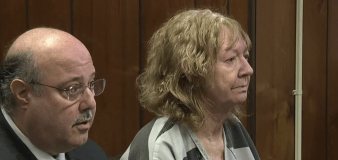
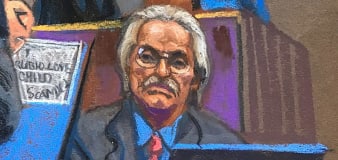
Those documents, revealed Wednesday in Columbus, outline a sexual relationship between Celeste Caulley Bowman and attorney James Owen in 1997 and 1998, an affair that ended when Owen refused to leave his wife, the documents say.
"I was completely shocked to hear that this affair started while I was sitting in jail awaiting trial on murder charges," Caulley wrote in an affidavit. "I never would have guessed that Jim and Celeste were in a sexual relationship at the time."
A call to Owen was referred to an attorney who did not respond to AOL News immediately. Franklin County Prosecutor Ron O'Brien could not be reached for comment.
Caulley's parents were bludgeoned and stabbed to death in 1994 during a botched robbery. The bludgeoning weapon was a shotgun with a broken stock that was covered in blood belonging to one of the victims and an unknown male, according to DNA evidence.
Assistant Ohio Public Defender Kim Rigby told AOL News that Caulley's DNA profile was never proved to be on the gun.
"There is absolutely no physical evidence that points to Caulley as the perpetrator," she said.
The case went unsolved for three years. Then Caulley, an aeronautical engineer, was interrogated by police for 12 hours and confessed. He repeatedly asked for an attorney, but one wasn't provided. Caulley is arguing that his confession was coerced by a prosecutor who told him in a phone call to cooperate with police.

Rigby said Caulley deserves a new trial.
In her affidavit, Bowman said the affair with Owen began when she offered to help do research and investigation on the case. They spent long hours working together. The first time they had sex was at a lakeside cottage that Owen owned, and the relationship continued through the trial, including the night Caulley was convicted.
"Jim then drove us to a hotel where we stayed until the early hours of the morning and again ended up having sexual relations," Bowman wrote. "Afterwards Jim wrapped his arms around me and told me he loved me, whispering, 'I love you, I love you, I love you.' "
Such behavior should be immediate grounds for a reversal on the conviction, but in reality Caulley and Rigby face an uphill battle, said Rob Warden, director of the Center on Wrongful Convictions out of Northwestern University.
"Once you are convicted, it's guilty until proven innocent," Warden told AOL News. "The hurdle for proving innocence is so much higher than proving guilt in the first place. It's so much easier to convict someone than to overturn a wrongful conviction; it's a double standard throughout the country."
"The courts think that anything that comes to light after the conviction is not worth considering," Warden said. "Sometimes the appellate court will say, 'Given overwhelming evidence of the defendant's guilt, this wouldn't make any difference. It's harmless error.' "
A hearing on the new motion has yet to be scheduled.

The Mortgage Mess: Just How Many Screwups Were There?