"I admire what you've done over the last two years. But it shouldn't have gotten to that," Sen. Christopher Dodd, chairman of the Senate banking committee, told the central bank chief at the hearing Thursday. "We shouldn't have had to go through what we did for the last two years ... had there been cops on the street doing their job, telling us what was going on and allowing us to avoid the problem in the first place."
Dodd, D-Conn., said he would vote to confirm Bernanke's nomination to a second term, as did several other Democratic and Republican lawmakers. The only committee member to voice opposition -- and vehemently -- was Kentucky Republican Jim Bunning, a longtime critic of the Fed chairman. And though Sen. Richard Shelby, the ranking Republican on the panel, found fault with the Fed's failure to head off the "fire sale" of assets that proved so costly to investors and the economy as a whole, he didn't say how he will vote.
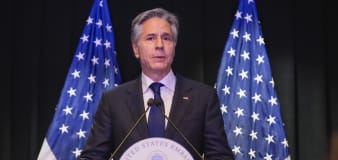
Federal Reserve Chairman Ben Bernanke listens during the Senate Banking, Housing and Urban Affairs Committee hearing on his nomination for another term as head of the nation's central bank.
Still, senator after senator stressed how dire the U.S. unemployment problem remains with an urgency that may increase if the monthly payroll report -- due tomorrow from the Labor Department -- is as bad as many economists expect. Bernanke made frequent reference to the Fed's discussion of an "exit strategy" from the loose monetary policy and low interest rates still in force. But the senators before him were much more concerned about jobs.
And however safe his own job may be, Bernanke had the air of a man under siege. On the defensive from his opening statement in the morning to the close of testimony in the afternoon, Bernanke was fighting to preserve the central bank's authority, as well as his own role.
"As severe as the effects of the crisis have been ... the outcome could have been markedly worse without the strong actions taken by the Congress, the Treasury Department, the Federal Reserve" and its sister agencies, Bernanke said. "It would be a tragedy if, after all the hardships that Americans have endured during the past two years, our nation failed to take the steps necessary to prevent a recurrence of a crisis of the magnitude we have recently confronted."
Dodd opened the hearing on Bernanke's nomination to a second term by stressing the importance of maintaining "a strong and very, very independent" central bank but suggested the Fed's broad responsibilities as a regulator may be distracting Fed officials from their key responsibilities of controlling monetary policy and interest rates and acting as the lender of last resort for the country's banks. The Fed should have found a way to prevent the subprime-mortgage meltdown and out-of-control risk-taking that led to the crisis and then recession, Dodd said.
The House Financial Services Committee -- which like its Senate counterpart is working on an overhaul of how the government keeps watch over banks, Wall Street and other financial industries -- Wednesday voted for a bill that would increase congressional oversight of the Fed. Hours later, Sen. Bernie Sanders, I-Vt., said he placed a hold on the Bernanke nomination because of the Fed's performance in recent years and Bernanke's earlier role as a key economic player in the administration of President George W. Bush. The hold may delay the nomination but, on its own, seems unlikely to defeat it if Bernanke can win broader support in the Senate. Sanders isn't a member of the banking committee.

Bernanke reminded the committee that it was Congress, in 1978, that shielded the Fed's making of monetary policy -- and its role of balancing maximum job creation with inflation prevention -- in order to protect it from "short-term political pressures."