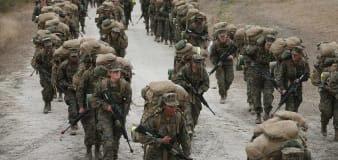
Grunts will no longer suffer through the tried-and-true standard: long-distance runs, bayonet drills and, of course, the "drop and give me 20" at the behest of their drill sergeant.
Instead, they'll focus on calisthenics such as stretches, leg raises and abdominal workouts to improve core strength. Troops are also being trained in "rolling techniques" and in hands-on combat using improvised weaponry like pipes and wood planks.
The logic behind the ab-crunching, plank-wielding fitness plan is twofold: Army instructors say they want to closely mimic the realities of modern combat, and also toughen up troops who've grown up lazier and more coddled than their predecessors.
"Most of these soldiers have never been in a fistfight or any kind of a physical confrontation. They are stunned when they get smacked in the face," Capt. Scott Sewell, who oversees trainees, told The Associated Press. "We are trying to get them to act, to think like warriors."
Warriors, that is, who are more likely to dash across an alley than trek cross-country. "We don't run five miles in combat, but you run across the street every day," said Frank Palkoska, the head of the Army's Fitness School.
And with drones and robots an increasingly common part of war, modern warriors also spend plenty of time behind a desk, at a computer or on the phone. Those revamping the fitness plan acknowledge that physical combat often comes second to cell phone proficiency in today's war zones.
The new fitness program might be more functional, but it's also tamer. And that's well-suited to this generation of Army recruits: They're softer and sicker, and, according to the Pentagon, 75 percent of them aren't even fit to serve.
Last November, Curt Gilroy, the Pentagon's director of accessions, told Army Times that most American teens were obese, out of shape and plagued by illness because of "couch potato syndrome."
"Kids are just not able to do push-ups, and they can't do pull-ups, and they can't run," he said.
Fortunately, the new Army workout plan doesn't ask them to.
So what can Army grunts expect when they start their basic training? They'll be rolled along the ground to mimic falling from a Humvee. They'll also engage in alternating series of stretches, lunges and zigzag sprints, and lift decidedly warlike objects -- mannequins, ammunition cans -- over their heads.
They'll also delight in moderation. No strengthening move can be repeated more than 10 times a session, and troops can't run longer than 30 minutes a day.
Somehow, moderation just doesn't evoke the sense of physical torment that's long been a mainstay of military boot camp. Beverly Bartlett, a reporter stationed in Louisville, Ky., who often covers the military, recalls that even witnessing -- let alone partaking in -- an Army boot camp "was an unforgettable experience."
Compare that to the reaction of newly minted Pvt. Brendon Rhyne after a recent early-morning calisthenics session at Fort Jackson in South Carolina.
"This is the funnest day I've had since I've been here!" the 21-year-old recruit told the AP.